
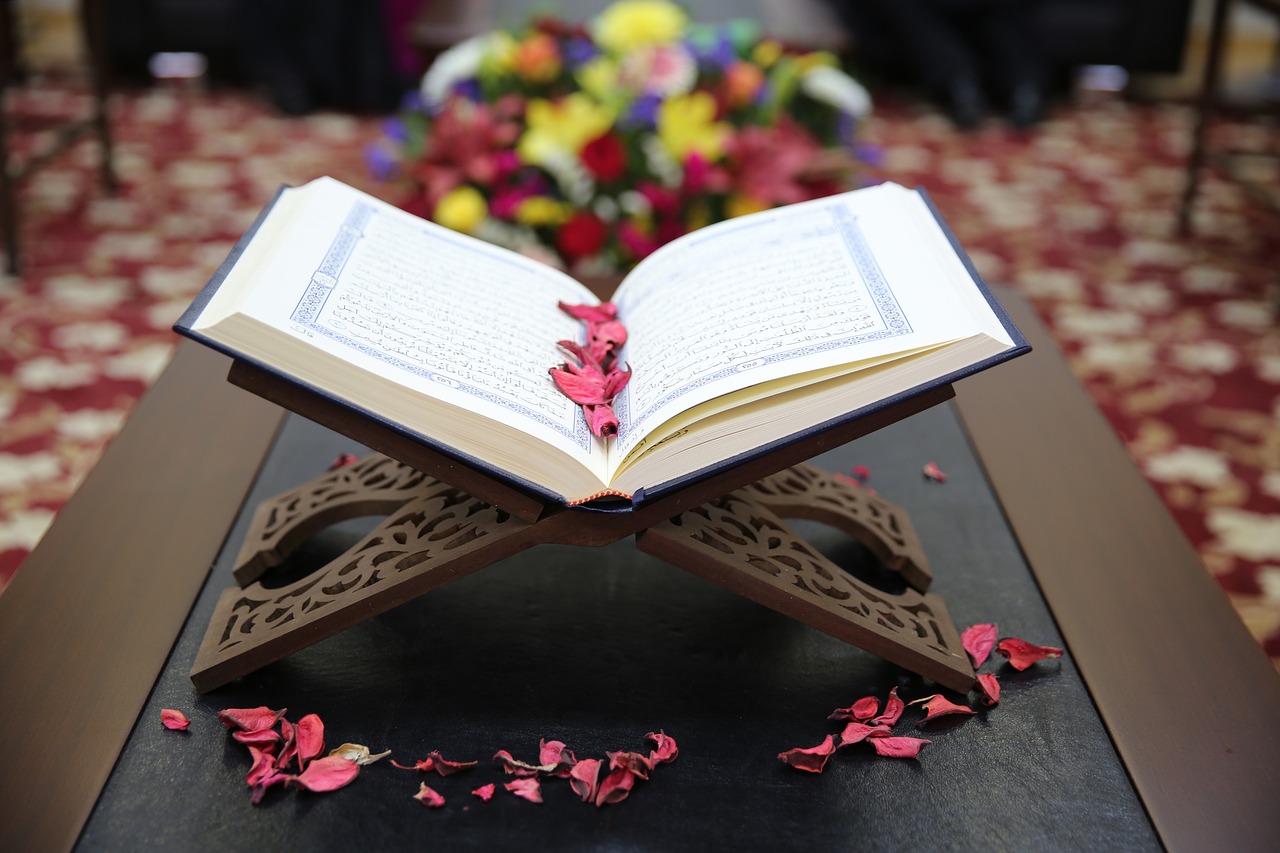
Qur’an
Mankind is the elitist creation on the surface of this earth, in the known universe we are second to none. The purpose of our existence is to gain the result of Allah’s pleasure, consequently rewarded with the eternal bliss of Jannah (paradise). Our code of life is embodied within the Qur’an. Essentially, the Qur’an directs man towards a way of life which is equally good in all spheres of human activity. Those who live according to its principles it serves as a spiritual medication as well as psychical. It describes previous events that have taken place as a reminder, as a warning. It defines the morals, manners, characters, and attributes desirable for all mankind. The Qur’an in itself is enduring, not time or era bound. It makes no distinction between past and present, old and new. Its approach is general, yet remains the same for all types of culture and lives. Allah declares in the Qur’an:
“In their narratives there is certainly a lesson for people of intelligence. This Qur’an is not a fabricated tale, but a confirmation to all the scriptures before it, a detailed explanation of all things, a guidance and a mercy for all the believing folk.” (Surah Yusuf 12-111)
In this verse few things has been established. Firstly, “In their narrative there is certainly a lesson for people of intelligence.” These are the very few who ponder and deliberate over the subject matter that is contains. Secondly, Allah says, “The Qur’an is not a fabricated tale.” The contents of this divine book is the truth from Allah and is not the product of any human. Finally, Allah says that the Qur’an is “A confirmation to all the scriptures before it.” It contains the teachings of the previous scriptures. Therefore, the Jews and the Christians should be especially influenced by it. Addressing the Jews in Surah Baqarah, Allah says,
“Believe in what I have revealed in confirmation of what you have with you, and do not become the first disbelievers.” ( Ayah 41)
Earlier religions are deficient as compared to Islam because they were meant for a specific time. Whereas the Qur’an is not bound by time, its teaching is universal. The four heavenly books that were revealed to their respective messengers: the Bible to Esa (Jesus) a.s, the psalms to Dawood (David) a.s, the Torah to Musa (Moses) a.s and the Qur’an to Prophet Muhammad (Paracaleet, as mentioned in the Bible) s.a.w. The final book being the Qur’an confirms and attest to these divine books. Through the passage of time they were altered save the Qur’an. All these revealed books apart from the Qur’an were sent down for a certain period of time which was precise, and the books were never meant to be eternal. The Qur’an was sent as the final replacement which was tampered-proof, and encompasses all the previous principles of the divine books before they were distorted, and will be preserved until the day of resurrection. Allah proclaims in the Qur’an:
“Without doubt we have revealed the reminder (Qur’an) and we shall certainly be its protector.”(Surah Hijr 15-9)
Allah informs those who rejected the Qur’an that it will remain as the truth even though they wish to refute it. The disbelievers also use to say that the Qur’an is not from Allah, and if it is, it will not last very long. Allah replies robustly informing them that he shall be the one to preserve it until its allotted time which he has prefixed.
There are some verses of the previous books, which are very similar in the verses of the Qur’an and are true if they corroborate with the principles of the Qur’an. However the ones that differ with the principals will not be accepted.
“And we have sent down to you the book in truth, confirming the scripture that came before it.”(Surah Maidah 5-48)
The revelation of the Qur’an happened over a period of twenty-three years. In the manner how it was manifested to prophet s.a.w happened in various ways and have been recorded in the books of Ahadith (traditions) meticulously. Once Harith ibn Hisham r.a a noble companion of Prophet s.a.w asked him how the revelation came to him. He answered, “at times it comes to me like the chiming of a bell, and this mode of revelation is the hardest on me. Then it comes to an end when I fully comprehend the words of the angel, and I commit them to my memory. And at other times, the angel comes to me in the form of a man who talks to me, and I comprehend and memorise what he says.”(Musnad Ahmad 2:107)
When the angel took a human form for the delivery of the holy passages, the angle normally morphed into the appearance of Dihyah Kalbi r.a. A sahabi who was famous for his masculine beauty and handsomeness.
Sayyidah Aisha r.a has also narrated that even in the coldest days of winter, when he received the divine revelation, his forehead used to be full of sweat due to the stress he felt during the experience. (Bukhari)
Another prominent Sahabi, Zaid ibn Thabit r.a narrates that once the Prophet s.a.w was putting his head on Zaid’s thigh when suddenly revelation started descending on him. He felt such a pressure on his thigh that it seemed almost to be crushed by the pressure. (Bukhari)
Immediately after receiving revelation Prophet s.a.w would call his companions and relay the message to them and in turn it would be memorised. Additionally, the early Muslims had a deep attachment and were dependent on the Qur’an for their prayers, law, social order and life in general.
“Certainly, we have brought to them a book which we have explained in detail with knowledge-a guidance and a mercy to a people who believe.” (Surah A’raf 7:52)
The Qur’an is a miracle not in the terms of its eloquence and excellence but in its words, their order, subject matter, meaning, knowledge and information of the unseen. It professes religious, moral, social and civic knowledge. As well as being a guide for humanity the Qur’an contains much information about history, geography, physics, astronomy, celestial bodies, life sciences, medicine and the creation of men. The Qur’an is not a scientific book, nor was its purpose for such genre. Conversely there is nothing in the Qur’an that contradicts modern discoveries, if it does, it means scientifically the theory has not been fully comprehended or reached its potential in discovery. The Qur’an contains realities which have only recently come to be known by science.
The Prophet s.a.w was reported to have said, “I am leaving behind for you something so valuable that if you hold fast to it you will not go astray and that is the book of Allah-the holy Qur’an.” It is a requirement that every Muslim and their children know how to read the Qur’an according to the science of Tajweed (Makhaarij, origin of pronunciation and Sifaat, the quality of delivery of each letter). A supreme divine book like the Qur’an will not descend from the heavens without any prerequisite, thus the scholars have numbered the rights of the Qur’an upon us.
1. To recite it correctly in the manner it was revealed and as the Prophet s.a.w recited it.
2. Make an endeavour to understand it.
3. To act on its teachings and guidance.
If anyone gives the Qur’an its three rights with sincerity, then he will be considered to have fulfilled all of its rights. However, if he fails to fulfil any rights of the rights, then he will be considered it have not fulfilled the rights of the Qur’an.
Certain people hold the deluded opinion that reading and memorising the Qur’an like parrots, without understanding its meaning is not necessary, because we do not understand its meaning. May Allah protect us from such satanic thoughts which has been whispered into the ears of these laymen. The answer to this misconception is; the Prophet s.a.w was sent for different purposes which is all encompassed within the Qur’an which it mentions frequently, but two things it mentions very distinctly:
“Recite your verses to them”
Prophet s.a.w is being commanded to recite to the Muslims, this was his primary task. Reciting the Qur’an is a task on its own, memorising the Qur’an is another, and understanding the meaning of the Qur’an based on the interpretation of the holy Prophet s.a.w., the companions, the tabi’een the tabi tabi’een, those scholars of the early age of Islam, and finally along the principles they have created so a sound interpretation within the boundaries of Islam can be grasped. Deriving laws from the Qur’an is yet another responsibility for the elite in the Ummah. Those people that claim it is unnecessary to memorise or read the Qur’an because you do not understand it, have not learnt their lesson from the experience of the Jews and the Christians. They lost their scriptures because they did not pay heed to its preservation. Although their scriptures are available in many language, the original scripture is adulterated and lost. Since there is no original with which to compare the translation, this leads to fabricating and bringing out new editions to meet the demand of the time.
The purpose of reading or memorising the Qur’an is not to identify which verse appears in which surah, or what the exact wording of a verse is. One of the most fundamental purposes of the Qur’an is that it should be recited and heard. This is an extremely effective means of drawing closer to Allah.
Ibn Masood r.a narrates:
“Prophet s.a.w told them that if anyone recited one letter of the book of Allah, he will be rewarded with one good deed, and each good deed will be multiplied ten times, he explained further, I don’t say that الم was one letter, but ا is a letter, ل is a letter and م is a letter.” (Tirmizi, Darami)
In accordance with Allah’s principle is that every deed man does it will be multiplied ten times as mentioned clearly in the Qur’an:
“Whoever brings a good deed shall have ten times the like of it.” (Surah An’am 6:160)
Through the recitation of the Qur’an a person can excel in rewards and position in the eyes of Allah. A book which has been sent for the guidance of mankind will act as an intercessor for those people who held it in their bosom and read from it with the hope of reward and its guidance descending upon them. The recitation of this auspicious book should not be taken lightly, sincere endeavour should be made to learn this book through the science of reciting and Tafseer (explanation, under a competent scholar). Through our struggles will only our station rise in the court of Allah. Many of us may not know how to read the Qur’an, or we frequently make mistakes. This should not disperse our resolve and make us hesitant of reading the words of our lord. In fact Allah encourages those weak people to read, Aisha r.a narrates:
“One who is skilled in the Qur’an is associated with the noble, upright recording angles, and he who falters when reciting and it is difficult for him, will have a double reward.” (Bukhari and Muslim)
The hadith indicates towards those skilful reciters of the Qur’an being at the station of those upright angels who are scribes and preserve what they need to preserve. They’ve been designated in this place for their skill, their interest in the Qur’an and they’ve developed close attachment with it through reciting it with sincerity. However, there are those believers who are not very fluent and lack the basic requirements of recitation. Despite their impediment they do not give up, they continue to read on with hope of acceptance and reward. This group of people will gain two rewards, one for their recitation (which doesn’t change the meaning, just lacks fluency) and another for the effort they made. Hence this group of people must not lose hope, especially when Allah hasn’t lost hope in them. This hadith has come to serve as means of encouragement to the weak reciters, but in logical sense the fluent reciters will be ahead in reward.
It is Fard Ayn (individual obligation) to learn the Qur’an. To preserve this knowledge and pass it down to the generations to come. This book is such with no equivalence or parity, has not been designated for any epoch, rather enduring through time and relevant always. It’s a solution to all our problems. Prophet s.a.w says, “Hold fast to the book of Allah. Therein you will find guidance and contentment of the heart.”Qur’an
باسم الله الرحمن الرحيم. الحمد لله رب العالمين والصلاة والسلام على رسوله الكريم أما بعد.
Mankind is the elitist creation on the surface of this earth, in the known universe we are second to none. The purpose of our existence is to gain the result of Allah’s pleasure, consequently rewarded with the eternal bliss of Jannah (paradise). Our code of life is embodied within the Qur’an. Essentially, the Qur’an directs man towards a way of life which is equally good in all spheres of human activity. Those who live according to its principles it serves as a spiritual medication as well as psychical. It describes previous events that have taken place as a reminder, as a warning. It defines the morals, manners, characters, and attributes desirable for all mankind. The Qur’an in itself is enduring, not time or era bound. It makes no distinction between past and present, old and new. Its approach is general, yet remains the same for all types of culture and lives. Allah declares in the Qur’an:
“In their narratives there is certainly a lesson for people of intelligence. This Qur’an is not a fabricated tale, but a confirmation to all the scriptures before it, a detailed explanation of all things, a guidance and a mercy for all the believing folk.” (Surah Yusuf 12-111)
In this verse few things has been established. Firstly, “In their narrative there is certainly a lesson for people of intelligence.” These are the very few who ponder and deliberate over the subject matter that is contains. Secondly, Allah says, “The Qur’an is not a fabricated tale.” The contents of this divine book is the truth from Allah and is not the product of any human. Finally, Allah says that the Qur’an is “A confirmation to all the scriptures before it.” It contains the teachings of the previous scriptures. Therefore, the Jews and the Christians should be especially influenced by it. Addressing the Jews in Surah Baqarah, Allah says,
“Believe in what I have revealed in confirmation of what you have with you, and do not become the first disbelievers.” ( Ayah 41)
Earlier religions are deficient as compared to Islam because they were meant for a specific time. Whereas the Qur’an is not bound by time, its teaching is universal. The four heavenly books that were revealed to their respective messengers: the Bible to Esa (Jesus) a.s, the psalms to Dawood (David) a.s, the Torah to Musa (Moses) a.s and the Qur’an to Prophet Muhammad (Paracaleet, as mentioned in the Bible) s.a.w. The final book being the Qur’an confirms and attest to these divine books. Through the passage of time they were altered save the Qur’an. All these revealed books apart from the Qur’an were sent down for a certain period of time which was precise, and the books were never meant to be eternal. The Qur’an was sent as the final replacement which was tampered-proof, and encompasses all the previous principles of the divine books before they were distorted, and will be preserved until the day of resurrection. Allah proclaims in the Qur’an:
“Without doubt we have revealed the reminder (Qur’an) and we shall certainly be its protector.”(Surah Hijr 15-9)
Allah informs those who rejected the Qur’an that it will remain as the truth even though they wish to refute it. The disbelievers also use to say that the Qur’an is not from Allah, and if it is, it will not last very long. Allah replies robustly informing them that he shall be the one to preserve it until its allotted time which he has prefixed.
There are some verses of the previous books, which are very similar in the verses of the Qur’an and are true if they corroborate with the principles of the Qur’an. However the ones that differ with the principals will not be accepted.
“And we have sent down to you the book in truth, confirming the scripture that came before it.”(Surah Maidah 5-48)
The revelation of the Qur’an happened over a period of twenty-three years. In the manner how it was manifested to prophet s.a.w happened in various ways and have been recorded in the books of Ahadith (traditions) meticulously. Once Harith ibn Hisham r.a a noble companion of Prophet s.a.w asked him how the revelation came to him. He answered, “at times it comes to me like the chiming of a bell, and this mode of revelation is the hardest on me. Then it comes to an end when I fully comprehend the words of the angel, and I commit them to my memory. And at other times, the angel comes to me in the form of a man who talks to me, and I comprehend and memorise what he says.”(Musnad Ahmad 2:107)
When the angel took a human form for the delivery of the holy passages, the angle normally morphed into the appearance of Dihyah Kalbi r.a. A sahabi who was famous for his masculine beauty and handsomeness.
Sayyidah Aisha r.a has also narrated that even in the coldest days of winter, when he received the divine revelation, his forehead used to be full of sweat due to the stress he felt during the experience. (Bukhari)
Another prominent Sahabi, Zaid ibn Thabit r.a narrates that once the Prophet s.a.w was putting his head on Zaid’s thigh when suddenly revelation started descending on him. He felt such a pressure on his thigh that it seemed almost to be crushed by the pressure. (Bukhari)
Immediately after receiving revelation Prophet s.a.w would call his companions and relay the message to them and in turn it would be memorised. Additionally, the early Muslims had a deep attachment and were dependent on the Qur’an for their prayers, law, social order and life in general.
“Certainly, we have brought to them a book which we have explained in detail with knowledge-a guidance and a mercy to a people who believe.” (Surah A’raf 7:52)
The Qur’an is a miracle not in the terms of its eloquence and excellence but in its words, their order, subject matter, meaning, knowledge and information of the unseen. It professes religious, moral, social and civic knowledge. As well as being a guide for humanity the Qur’an contains much information about history, geography, physics, astronomy, celestial bodies, life sciences, medicine and the creation of men. The Qur’an is not a scientific book, nor was its purpose for such genre. Conversely there is nothing in the Qur’an that contradicts modern discoveries, if it does, it means scientifically the theory has not been fully comprehended or reached its potential in discovery. The Qur’an contains realities which have only recently come to be known by science.
The Prophet s.a.w was reported to have said, “I am leaving behind for you something so valuable that if you hold fast to it you will not go astray and that is the book of Allah-the holy Qur’an.” It is a requirement that every Muslim and their children know how to read the Qur’an according to the science of Tajweed (Makhaarij, origin of pronunciation and Sifaat, the quality of delivery of each letter). A supreme divine book like the Qur’an will not descend from the heavens without any prerequisite, thus the scholars have numbered the rights of the Qur’an upon us.
1. To recite it correctly in the manner it was revealed and as the Prophet s.a.w recited it.
2. Make an endeavour to understand it.
3. To act on its teachings and guidance.
If anyone gives the Qur’an its three rights with sincerity, then he will be considered to have fulfilled all of its rights. However, if he fails to fulfil any rights of the rights, then he will be considered it have not fulfilled the rights of the Qur’an.
Certain people hold the deluded opinion that reading and memorising the Qur’an like parrots, without understanding its meaning is not necessary, because we do not understand its meaning. May Allah protect us from such satanic thoughts which has been whispered into the ears of these laymen. The answer to this misconception is; the Prophet s.a.w was sent for different purposes which is all encompassed within the Qur’an which it mentions frequently, but two things it mentions very distinctly:
“Recite your verses to them”
Prophet s.a.w is being commanded to recite to the Muslims, this was his primary task. Reciting the Qur’an is a task on its own, memorising the Qur’an is another, and understanding the meaning of the Qur’an based on the interpretation of the holy Prophet s.a.w., the companions, the tabi’een the tabi tabi’een, those scholars of the early age of Islam, and finally along the principles they have created so a sound interpretation within the boundaries of Islam can be grasped. Deriving laws from the Qur’an is yet another responsibility for the elite in the Ummah. Those people that claim it is unnecessary to memorise or read the Qur’an because you do not understand it, have not learnt their lesson from the experience of the Jews and the Christians. They lost their scriptures because they did not pay heed to its preservation. Although their scriptures are available in many language, the original scripture is adulterated and lost. Since there is no original with which to compare the translation, this leads to fabricating and bringing out new editions to meet the demand of the time.
The purpose of reading or memorising the Qur’an is not to identify which verse appears in which surah, or what the exact wording of a verse is. One of the most fundamental purposes of the Qur’an is that it should be recited and heard. This is an extremely effective means of drawing closer to Allah.
Ibn Masood r.a narrates:
“Prophet s.a.w told them that if anyone recited one letter of the book of Allah, he will be rewarded with one good deed, and each good deed will be multiplied ten times, he explained further, I don’t say that الم was one letter, but ا is a letter, ل is a letter and م is a letter.” (Tirmizi, Darami)
In accordance with Allah’s principle is that every deed man does it will be multiplied ten times as mentioned clearly in the Qur’an:
“Whoever brings a good deed shall have ten times the like of it.” (Surah An’am 6:160)
Through the recitation of the Qur’an a person can excel in rewards and position in the eyes of Allah. A book which has been sent for the guidance of mankind will act as an intercessor for those people who held it in their bosom and read from it with the hope of reward and its guidance descending upon them. The recitation of this auspicious book should not be taken lightly, sincere endeavour should be made to learn this book through the science of reciting and Tafseer (explanation, under a competent scholar). Through our struggles will only our station rise in the court of Allah. Many of us may not know how to read the Qur’an, or we frequently make mistakes. This should not disperse our resolve and make us hesitant of reading the words of our lord. In fact Allah encourages those weak people to read, Aisha r.a narrates:
“One who is skilled in the Qur’an is associated with the noble, upright recording angles, and he who falters when reciting and it is difficult for him, will have a double reward.” (Bukhari and Muslim)
The hadith indicates towards those skilful reciters of the Qur’an being at the station of those upright angels who are scribes and preserve what they need to preserve. They’ve been designated in this place for their skill, their interest in the Qur’an and they’ve developed close attachment with it through reciting it with sincerity. However, there are those believers who are not very fluent and lack the basic requirements of recitation. Despite their impediment they do not give up, they continue to read on with hope of acceptance and reward. This group of people will gain two rewards, one for their recitation (which doesn’t change the meaning, just lacks fluency) and another for the effort they made. Hence this group of people must not lose hope, especially when Allah hasn’t lost hope in them. This hadith has come to serve as means of encouragement to the weak reciters, but in logical sense the fluent reciters will be ahead in reward.
It is Fard Ayn (individual obligation) to learn the Qur’an. To preserve this knowledge and pass it down to the generations to come. This book is such with no equivalence or parity, has not been designated for any epoch, rather enduring through time and relevant always. It’s a solution to all our problems. Prophet s.a.w says, “Hold fast to the book of Allah. Therein you will find guidance and contentment of the heart.”